
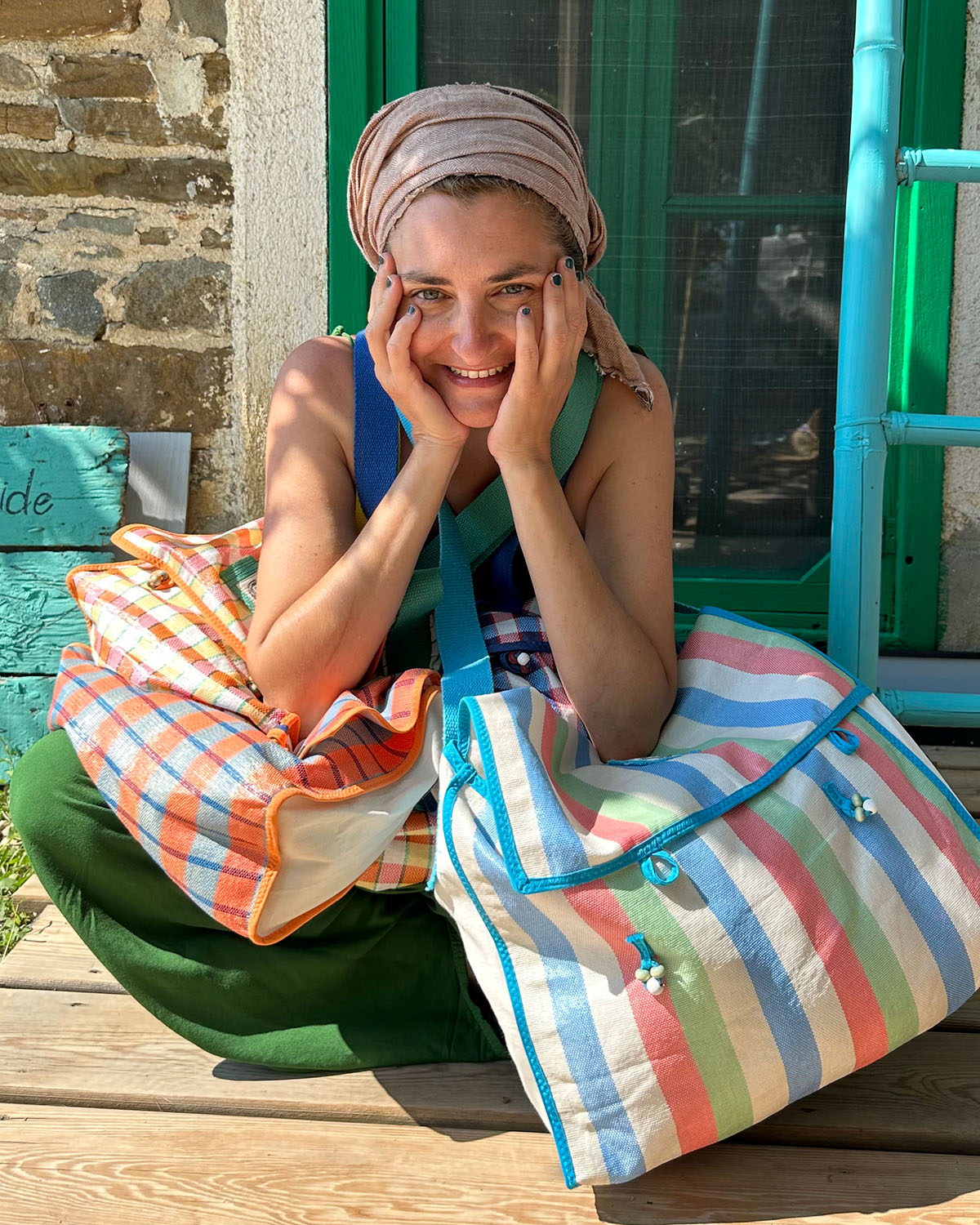
A Conversation on Waste, Design, and Labor
Veli: Greetings, let me start by introducing myself. I am a graduate of Marmara University, Department of Interior Architecture, and I am interested in upcycling. I am developing a studio called Makara Design Studio, where I plan to design furniture and spaces using waste materials and work on the upcycling agenda. In the March issue of the 'What Do Young People Say?' newsletter, supported by ALİKEV, we wanted to make the feminist perspective visible. I wanted to interview you because of your work on upcycling and the importance you place on women's labor. Could you tell us about yourself so the readers can get to know you?
Burcu: I am Havva Burcu İlhan. I graduated from Mimar Sinan University, Department of Industrial Product Design. For many years, I designed and implemented furniture, product display stands, fair booths, and interior designs. Later, faced with the realities of life, I reached a threshold where I decided to throw the unsustainable part of the design business into the compost bin. With Kabuk, I began to be the one who designs, produces, has produced, markets, and sells with an understanding that provides more benefit to the nature I am a part of; and I still continue.
Veli: Your venture starts with your sensitivity to waste and being a designer. The bags produced from the waste materials you use must have caught attention, as a bag design was requested from you in relation to your designer side. What did you feel when you received the bag design request, the first work of the brand?
Burcu: Actually, this journey did not start from waste at first. In 2011, when Buğday Association asked me to design a bag for the Ecological Market, Kabuk Bags transformed from local market bags emerged. Until that process, I had volunteered in some collaborations with Buğday Association. I designed the first work of our brand, the bag, and this was a surprise for me too.
Veli: How did the process develop from the ecological bag design process started with Buğday Association's request to founding your own brand?
Burcu: Buğday Association is already an organization that creates significant effects on everyone it touches and aims to leave positive traces in life. These bags were also a turning point in my life. The first stop of the design journey that started for them was experiencing the place where the brand was created.
The story is like this; the local market bags I was already using while going to ecological markets were, in my opinion, more ecological than a cloth bag. They were long-lasting, sturdy, didn't get wet from the vegetables and fruits placed inside without bags, and you could place them on the ground without worry. When they got dirty, they could be cleaned by wiping. However, in their original sewn state, they weren't very functional or aesthetic. The handle hurt the hand and didn't distribute the weight. Initially, to make this more comfortable, I added a shoulder strap. Later, I saw that combining them with raw fabrics integrated with the plastic weave, softening the bag's hard plastic feel. Actually, we combined function with aesthetics here, made it more fun, and after many different trials, many models emerged.
Therefore, we went beyond designing bags for the Buğday Association and opened our first stall in Şişli Ecological Market next to the Buğday Association. Afterwards, many shops and people who saw and liked the idea wanted to give them space. Purchases started in various parts of Turkey and especially in summer resorts. We made our first online sale on the formation called Limango Ard.
Veli: Your Kabuk Project, which you carried out during your Industrial Design education at Mimar Sinan Fine Arts University, also turned into your brand name. Can you talk about the relationship between the Kabuk Project and Kabuk Studio?
Shell (Kabuk) is a very meaningful concept: the shell heals, the shell is what is left behind, the shell changes. It is aesthetic, it is geometry, it is design. This name felt impressive to me and became a name that matches my work.
Burcu: My diploma project at Mimar Sinan was an egg cooking unit. Where did the egg cooking unit come from? The summer before my diploma project, I went to America with the work and travel program, and in the breakfast restaurant where I worked, they made many different kinds of eggs and presented them to people. The subject of the diploma project was to design products for hotels and holiday villages. Inspired by this experience, I wanted to design an egg cooking unit, and since the subject was eggs, its name became Kabuk (Shell).
Later I thought about it. Shell is a very meaningful concept: shell heals, shell is what is left behind, shell is change, transformation, aesthetics, geometry, design. This name was impressive to me and became a name that coincided with my work. Also, the name of our design office became Kabuk. For many years, I designed interiors, furniture, trade fair stands, and product display stands with my friends, and at that time, the name of our company was Kabuk Design.
Exhibition stands and product display stands are set up for a very short time and then become trash. In general, I think a lot about not producing waste in my approach to life, so it became contradictory to me. I didn't want to include unsustainable work in my life anymore.
Veli: So what are the reasons why you do not want to have a mass production process in manufacturing?
I used to think that mass production wouldn't align well with the spirit of this work. Actually, I think a bit differently now. It's not a savage production, but I'm trying to capture a model in between boutique and mass production, because actually such a boutique production is not sustainable.
Burcu: The market bags we use are made of woven fabric and it is a fabric that needs to be sewn very delicately because it can fray. Mass production machines move very fast and they can cause fraying. On the other hand, we create them all one by one by hand and with different touches. The lines and threads on them are chosen very spontaneously and no two are identical.
In the early years, I deliberately didn't want to enter the mass production process. I thought that mass production wouldn't overlap much with the spirit of this work. Currently, I think a bit differently. It's not a very savage production, but I'm trying to find a model in the middle of boutique and individual production. Because in fact, such a boutique production is not sustainable. Therefore, I now think that we can make bags with faster sewing machines, which are still sensitive and have our signature touches on them.
Veli: Can you talk about the reasons why you mostly have women in your organization?
Solidarity contributes to women being self-sufficient, creating their own social environment, and being able to exist here. I think society transforms as much as women feel valued.
Burcu: Actually, not only women are in our organization, but mostly women. Instead of working with a textile workshop that works as a subcontractor in a mass textile workshop, I wanted to work with women trying to provide income for themselves and we found each other during the process.
Solidarity contributes to women being self-sufficient, creating their own social environment and being able to exist here. In my opinion, as much as women feel valuable, society also transforms. That's why I care more about working with women, but I also worked with male friends I came across. I worked with my friend Mehmet, who is a sewing teacher at public education in Gökçeada, then there are student friends here and a trans friend we work with. So we don't actually discriminate, but somehow we meet more intensely with women.
Veli: I understand you get waste materials from your immediate surroundings and small-scale vendors. Do you have an agreement on supplying waste material from large-scale production firms? Do you think such a cooperation could reduce the environmental damage of capitalist production methods while creating transformative effects?
We have mentioned mottos like be part of transformation, use don't throw away, and we are actually inviting. We say take care of your packaging because it is produced at infinite speed, consumed at infinite speed, and this cannot be prevented.
Everyone wants to get rid of their trash, we see that. Trash is produced, and while previously this wasn't in sight and they could turn their backs on it, now they are in a situation where they cannot turn their backs. Because they can't turn their backs and it's getting tangled in their feet, they've started searching for solutions for what to do with those tangled things.
Burcu: We supply waste materials from our immediate surroundings. We buy from the coffee shops here. Our friends, spouse, friends bring their waste packaging. Apart from that, we cooperated with Skoda, we transformed their waste posters. We received posters from the Municipality. We bought posters from Penti and transformed them into beach bags.
Honestly, I care a lot about this part of the work. We can only transform to a certain point with the waste packaging we collect from our surroundings. I'm sure the transformability of large companies will create a lot of impact. We mentioned mottos like be part of transformation, use don't throw away and this is an invitation actually. We say take care of your packaging because it is produced at infinite speed, consumed at infinite speed and this cannot be prevented. Sometimes I feel that the things we do to improve are insufficient and we are wasting time, but this is what we can do and we will continue to do it.
Everyone wants to get rid of their trash, we see that. Trash is produced and while it was not in sight and they could turn their backs on it before, now they are in a situation where they cannot turn their backs. Because they can't turn their backs and it's getting tangled in their feet, they started searching for solutions for what to do with those tangled things. With our small capacity, we can only be an inspiration and open a path, but if there are some financial resources to support us, of course we can also realize big projects, we see that power in ourselves.
Veli: In your production, you use easily accessible daily waste materials. It seems like an effective strategy to reduce the amount of waste produced by a city dweller. You seem sensitive on this point, and are there different approaches you think could be developed to reduce waste production?
It is necessary to make not producing trash more attractive. For example, there should be a return to the deposit system. Paid gift wraps led people to make their own gift wraps. Paid bags allowed us to use our own bags many times when going to the market.
Burcu: To reduce waste production, one should first start from the source. Let's transform what is produced into something else, but that transformation is also an effort, and should we actually give the effort here? No, I don't think we should give it here. We should give the effort to not producing trash, and whatever the way not to produce trash is, some decisions should be made at the political level, laws should be regulated and implemented. It should start from schools, from homes. It should start from the smallest household, from the individual.
It is necessary to make not producing trash more attractive. For example, there should be a return to the deposit system. Paid gift wraps led people to make their own gift wraps. Paid bags allowed us to use our own bags many times when going to the market.
Veli: What are the projects you are planning for the development of your brand? Are you in interaction with communities with similar concerns and are you considering collaborations?
We always consider collaboration, but on the other hand, creating an economy in collaborations is our priority because we need to sustain our own studio. We no longer have the luxury of going somewhere voluntarily and doing things.
Burcu: There are projects we are planning for the development of our brand. And these are, yes, with communities that have shared concerns. We are in interaction through social media. We always consider collaboration, but on the other hand, creating an economy in collaborations is our priority because we need to sustain our own studio. We no longer have the luxury of going somewhere voluntarily and doing things. I did it for many years, but now I care about people knowing that this is labor and that there should be a return. There is a huge amount of human labor behind this and it needs to be realized. There is labor in terms of production, there is labor in terms of mind.
I have a few projects I am considering working on upcycling with different and again waste materials. These are products that will eliminate large waste, aimed at different needs from other materials, and each one can be created with its own brand and are ideas open to development, but of course I cannot do them alone.
The togetherness of people from different fields is needed, a larger production and storage area is needed. Young minds like yours, who will take ownership of the work and see it as a need for all of us, are needed. Of course, financial resources are needed. These are projects that will provide job opportunities to people after these needs are met and eliminate a lot of waste from the surroundings. I hope they come to life and we all benefit from them.
Veli: Your insights were very valuable. They made us think again about waste, upcycling, and women's labor. Having mentioned all this, I believe both Kabuk Studio’s designs and Buğday Association’s page should definitely be explored. Thank you very much. We will be following your work with pleasure.