A Conversation on Play, Materials, and Circular Design
Veli: To talk a bit about myself, I am a graduate of Marmara University, Department of Interior Architecture, and I am interested in upcycling. I am developing a design studio called Makara Design Studio, where I plan to design furniture and spaces using waste materials and work on the upcycling agenda. We are preparing a newsletter called 'What Do Young People Say?', supported by ALİKEV, through which we want to make youth issues visible. I was impressed when I saw your work because you design and produce aesthetic, clean, and most importantly, educational products on a small scale using waste materials. Could you tell us about yourself so our readers can get to know you?
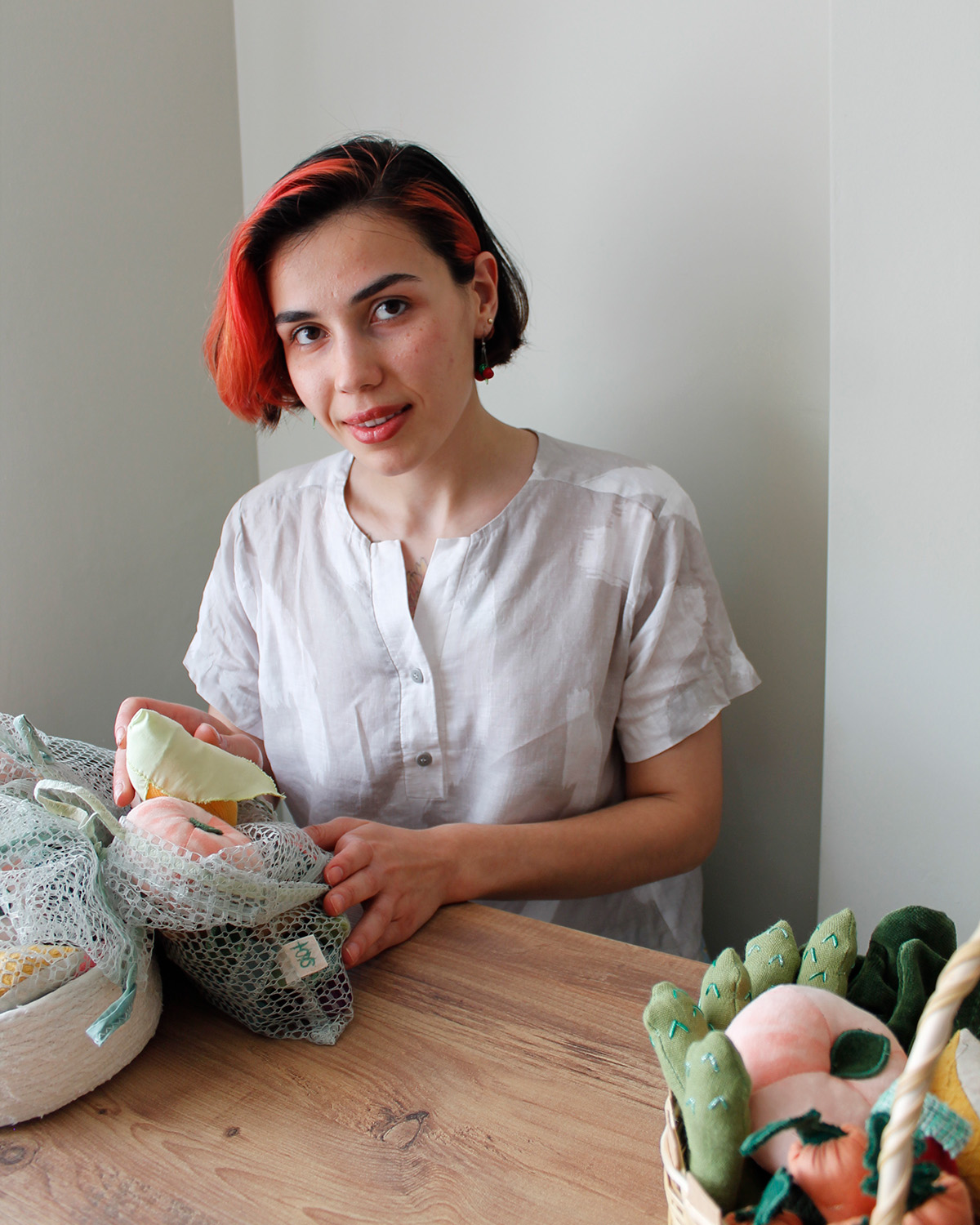
Zahide: Hello, I am Zahide Genç. I have a brand called Tosy Toys, where I design upcycled baby books and toys and am currently the producer as well. I aim both to create designs that support babies' sensory development and to produce without consuming too many resources. I prefer to produce from materials that can be considered waste at the end of the day, such as misprinted fabrics, swatch fabrics, and unworn clothes. At the same time, I conduct workshops and various studies to pass on transformation awareness to children.
Veli: How did you encounter upcycling and how did your first designs develop?
“Actually, it was something that was always in my life and I learned much later that it was upcycling. When I was a child, my mother used to sew, no leftover pieces were thrown away and they were definitely evaluated and used as something else.”
Zahide: Actually, it was something that was always in my life and I learned much later that it was upcycling. When I was a child, my mother used to sew, no leftover pieces were thrown away and they were definitely evaluated and used as something else. For example, there is a cover left from my grandmother, she made a forty-patch by sewing small pieces of fabric in her hand and used it as a teapot and pot cover in her time. Then it was left to my mother, and my mother used to lay it under her when we went to visit her when my daughter was a baby so that she could play. It was also a very beautiful cover. There were a lot of different patterns and textures. A complete sensory development mat. For example, I can say that the design inspiration of my play mats came from here.
My first design is a baby book. I made the first prototypes when I was pregnant with my daughter, and frankly, they weren't very successful. It took more than two years for me to develop and produce Bebekkuş. We can say it's a story that the pandemic and life with a tiny baby brought to me. There is a story of attachment and separation in the book. Bebekkuş flies away from the nest, explores the world, and returns to its loving nest whenever it wishes. I needed a variety of textures of fabric to tell this story, and instead of buying rolls of fabric, I decided to use the plenty of unworn clothes and small fabric pieces I had. Later, by chance, I reached a firm's swatch fabrics and misprinted fabrics. Moreover, they were all in the patterns and textures I needed. I started producing using these materials.
Veli: Can you talk about the factors and people that influence the development of your product designs?
“I try to design products that answer questions like: what do babies love, how do they play, what and how is it beneficial for them to play with?”
Zahide: I can say that the development of my daughter and the development of the products I designed in connection with it proceed in parallel. Tosy Toys became like my second child. I did most of my R&D work with my daughter and her friends. I try to design products that will answer the questions of what babies like, how they play, what and how it is beneficial for them to play with. For this reason, I especially use textures and sounds.
I had designed a memory toy and I want to talk about it. Most parents keep their babies' first clothes for the future. It sits in a box or a frame and remains a very meaningful memory for the child when they grow up. I developed such an alternative design; the first year of babies is a time when they grow extremely fast and they can wear many clothes for a very short time. A memory set with a baby book, toy and name garland specially designed and produced from these clothes. Babies at one point ask about the material of everything and how it's produced; wouldn't it be great if the answer to the question 'what is this book made of?' was 'it was transformed from your clothes'! Both the baby will be able to play with this book-toy and we will be able to transfer the awareness of transformation to the future from a tiny age.
Veli: What materials do you use in your products and how do you obtain waste materials?
Zahide: I mostly try to use fabrics obtained from natural fibers, but sometimes I also evaluate fabrics containing polyester. Sometimes there are those who give unworn clothes from my surroundings, sometimes I come across production error fabrics or swatch fabrics of various companies. I also recycle our coffee packaging consumed at home and in the office.
Veli: So, if we go a bit deeper into your design process, there's a point I'm curious about. Do you design a product and search for materials according to its needs, or do the waste materials you encounter lead to a new product design?
Zahide: Actually, it's both. For books, I used to design first and then do the material research. For customized designs, design is needed according to the material, for example. I currently have a few products designed through materials and in the R&D process. I had wanted to use wool for a long time and I had to adapt the design of the play mats to wool. As it is a very variable and living process, new production processes can require going back and making revisions in designs.
Veli: You've made the design and the materials are ready. How do you organize the production process and what do you need?
Zahide: I thought I had handled the production process well so far. I was producing it myself, everything was under my control, but now I've started working with new producers and things have become a bit difficult. I have difficulty finding producers who can work according to the schedule and produce good work, and who are sensitive about sustainability. I think I need a producer with whom we meet at the same values.
Veli: I know you participated in the 'Circular Fashion Collective' project organized by the Devridaim Institute. Can you talk about the process of participating in this project and your work?
Zahide: I had wanted to take more sustainable steps for Tosy Toys for a while and I came across the Circular Fashion Collective. After the application process, I joined the collective and had the opportunity to meet and work with important people in the field of sustainability-circularity. Especially since I wanted to use wool in my toys for a while, I had reservations because it was a fiber that was difficult to maintain. When I met Ms. Gülen within the collective and started to get to know the material, I realized that I could use it. I believe that I will do enjoyable work in the coming periods with the contributions of this process.
The topic of this period was fragile structures in fashion and Hatay. Inspired by the peace silk and Hatay yellow works of Ms. Emel, whose works I follow with admiration, I designed a mini bag collection. I will be doing other studies related to this in the following periods. I hope it reaches wide audiences and is met with appreciation when I present it.
Veli: Are there any projects or collaborations you are trying to realize in the near future to develop your venture?
“Transforming with children makes me feel very close to my goal and I receive very pleasant feedback from parents.”
Zahide: I was doing an upcycling toy making workshop with children. I also want to be able to spare more time for my workshop studies because transforming with children makes me feel very close to my goal and I receive very pleasant feedback from parents. Also my collaborations with developing brands like mine. I can't talk about the works yet, but we are sure that very enjoyable works will come out. I also want to be able to produce my natural and conversion-oriented designs that I planned in the following periods, they will meet parents and little ones when the time comes.
Veli: Your insights were very valuable. They made us think again about waste, upcycling, and child education. Thank you very much. We will be following your work with pleasure.